


Description
PrymaLab · Research Use Only
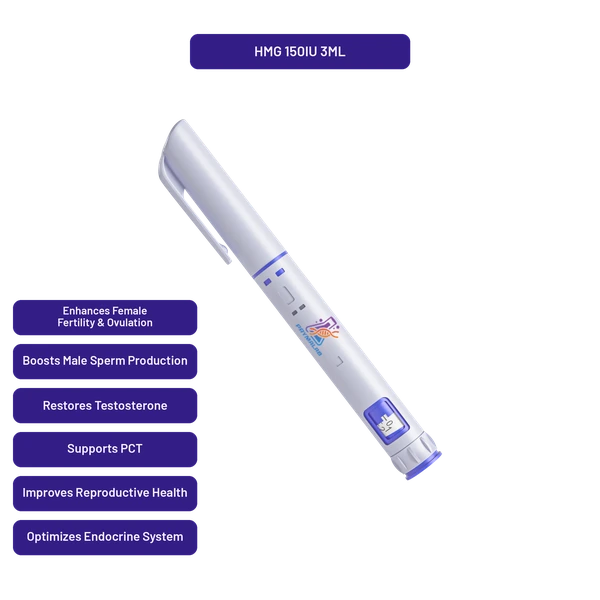
Preloaded Autoinjector | hMG (Menotropins) | 3ml Pen | 150IU
Gonadotropin glycoproteins in solution · 3ml at 50IU/ml · No reconstitution step
The hMG pen is a preloaded 3ml research autoinjector containing menotropins, a urine-derived mixture of follicle-stimulating and luteinising hormone activity, in solution at 50 IU/ml for 150 IU in the device. Potency here is a bioassay figure rather than a mass, so nothing about this material converts to milligrams without an assay.
Specification Table
| Property | Value |
|---|---|
| Device format | Preloaded autoinjector pen, glass cartridge |
| Fill volume | 3 ml |
| Concentration | 50 IU/ml |
| Total activity in device | 150 IU. The split between FSH and LH activity is [SPLIT] and is not stated on the product record |
| Molar concentration | Not convertible from IU without assay. Against the recombinant benchmark of 75 IU = 5.5 µg, 150 IU of FSH is about 11 µg of protein, near 3.7 µg/ml, or roughly 120 nM at 30 kDa |
| Compound | Menotropins (hMG): human FSH and LH activity purified from postmenopausal urine |
| CAS number | Menotropins 61489-71-2; follitropin 146479-72-3; luteinizing hormone 9002-67-9. FDA UNII 5Y9QQM372Q |
| Molecular formula | Not applicable. A glycoprotein mixture, not a single chemical entity |
| Molecular weight | FSH about 30-35 kDa; LH about 28-30 kDa |
| Amino acid composition | Two non-covalent heterodimers sharing the same 92-residue alpha subunit; FSH beta 111 residues, LH beta 121 residues; 11 disulfides per dimer and none linking the two chains |
| Glycosylation | N-glycans at alpha Asn52 and Asn78, FSH beta Asn7 and Asn24, LH beta Asn30. Sialic acid content sets isoform acidity and circulating half-life |
| Potency basis | International Units by rat bioassay against a WHO International Standard (Fourth IS, November 2000) |
| Solution appearance | Clear and colourless; no particulate |
| Reconstitution required | None. Supplied as solution |
| Excipient system | Not published on the product record. Both approved formulations carry a non-ionic surfactant. Confirm against certificate of analysis |
| Solution pH | Not published on the product record |
| Storage | 2-8°C, protected from light. Do not freeze |
| Light sensitivity | Real. Trp, Tyr and His photo-oxidation and disulfide photolysis; the approved product’s label says protect from light |
| Solution stability | No stability, potency or sterility data exist for menotropins at 50 IU/ml or in an unpreserved multidose container |
| Principal degradation route | Dissociation of the non-covalent alpha/beta dimer. Free subunits are inactive |
| Adsorption | High in dilute solution. At 50 IU/ml the protein content is single-digit micrograms per millilitre |
| Purity | Per lot-specific certificate of analysis. Chromatographic purity does not describe potency |
| Regulatory status | Approved menotropin products exist (Menopur, Ferring; US NDA 21-663 approved 2004, menotropins first approved in the US in 1975). This research preparation is not one of them and has no bioassay-established potency |
What Changes When Menotropins Ship in Solution?
Every other product in this catalogue is a small molecule whose failure is a broken covalent bond. Menotropins fail a different way: the two chains that make each hormone are held together by nothing but shape, and when they come apart the material is inactive while every atom is still present.
Both hormones here are heterodimers built on a cystine-knot fold. An identical 92-residue alpha subunit pairs with a 111-residue FSH beta or a 121-residue LH beta, and the pairing is entirely non-covalent: eleven disulfide bonds hold each chain’s own fold together and not one of them crosses between the chains. Heat, acid, denaturants, air-liquid interfaces and hydrophobic surfaces all push the equilibrium toward free subunits, and free subunits do not bind their receptors. Nothing about that shows up on a mass measurement, on a chromatographic purity figure, or in the appearance of the solution.
The covalent chemistry runs alongside it. Alkaline pH and free thiols scramble or reduce the disulfides that hold each fold; asparagine and glutamine deamidate and aspartates isomerise, generating charge variants; and oxidation of methionine, tryptophan, histidine and tyrosine is enough of a recognised liability for FSH that the recombinant liquid pen includes L-methionine as a sacrificial antioxidant. A formulator does not spend a slot on free methionine unless oxidation has shown up in a stability study.
Then there is the sugar. Each subunit carries N-glycans (alpha at Asn52 and Asn78, FSH beta at Asn7 and Asn24, LH beta at Asn30), and the sialic acid capping them sets both the isoform’s acidity and how long it survives in circulation. Losing sialic acid changes the mass by a rounding error on a 30 kDa glycoprotein and can halve the circulating half-life, which makes it the second invisible change in a molecule that already has one.
Concentration is where this device parts company with every validated menotropin format. At 50 IU/ml the protein content is single-digit micrograms per millilitre, which is exactly the regime in which glass, elastomer and hydrophobic plastic strip a meaningful fraction of a glycoprotein out of solution. Both approved products answer that with a surfactant: polysorbate 20 in the lyophilised menotropin product, poloxamer 188 in the recombinant FSH pen. Whether this fill contains one is not stated. Sialylated isoforms carry an isoelectric point mostly below 5, so they are anionic at neutral pH and less drawn to glass, but that offers no protection at all against a hydrophobic plunger.
The approved products also show what an in-use period looks like when someone has measured it. The 1200 IU menotropin presentation reconstituted with a metacresol-containing solvent to 600 IU/ml is validated for 28 days at not above 25°C, and the recombinant FSH pen for 28 days after first opening. Both figures belong to preserved formulations at 600 IU/ml or above, and neither transfers to an unpreserved solution twelve times more dilute.
What Is HMG Peptide, and Why Is That Name Wrong?
The phrase “what is hmg peptide” is the way most people search for this material, and the honest answer starts by rejecting the noun: hMG is not a peptide but a mixture of two glycoprotein hormones, each around 30 kDa, each a pair of chains carrying five to six disulfides and several branched sugars.
The distinction is practical rather than pedantic. A peptide can be described by a sequence, a mass and a purity figure; a glycoprotein hormone cannot, because its activity depends on a fold, on a non-covalent pairing, and on glycan structures that vary from lot to lot. That is why potency is stated in International Units from a rat bioassay, and why an HPLC purity number on a certificate of analysis says nothing about how much activity is in the cartridge. Answering “what is hmg peptide” with a molecular weight and a purity percentage is already an error. The page on what counts as a peptide sets out where the boundary falls.
One more piece of the composition is worth stating plainly. In highly purified menotropin products, part of the labelled LH bioactivity is supplied by chorionic gonadotropin from pregnancy urine: the UK summary of product characteristics says hCG may be added to reach the specified activity, and the US prescribing information states that hCG is detected in the product. What is in this research preparation is not documented.
What Does hMG 150IU Mean in a 3ml Pen?
hMG 150IU describes total bioassay activity, not mass: 150 International Units in 3 ml gives 50 IU/ml, and one 0.01 ml graduation carries 0.5 IU while 0.1 ml carries 5 IU.
An International Unit here is defined by animal bioassay against a WHO International Standard, the Fourth current from November 2000: FSH potency from the Steelman-Pohley ovarian-weight augmentation assay published in 1953, LH potency from a seminal-vesicle weight assay. That is why no exact conversion to milligrams exists. Against the recombinant benchmark, where 75 IU of follitropin alfa is labelled as 5.5 micrograms, 150 IU of FSH is roughly 11 micrograms of protein, about 3.7 micrograms per millilitre, or near 120 nM at 30 kDa. Urinary material has lower specific activity, so the true protein content per IU is higher. One 0.01 ml increment carries on the order of 0.04 micrograms of FSH protein.
The product record leaves one thing open, and it changes the arithmetic by a factor of two. Classic menotropin preparations carry FSH and LH activity in a 1:1 ratio, so “150 IU” can mean 150 IU of each activity (300 IU in total) or 150 IU of total activity split [SPLIT] between the two. Confirm which applies to a lot before any quantitative work.
Set 50 IU/ml against the concentrations anyone has validated. The approved lyophilised product is reconstituted to 75-450 IU/ml in the United States and to 600 IU/ml in the United Kingdom, and recombinant FSH pens run at 600-625 IU/ml. This device is 1.5 to 12.5-fold more dilute than any of them. The daily quantities used in the published stimulation trials, 150 to 225 IU, correspond to 3 to 4.5 ml here, which is the whole cartridge or more.
hMG Pen vs Vial: What Each Format Suits
The hmg pen vs vial comparison is unusual because the approved product is a lyophilised powder for a reason: a dry cake cannot dissociate, and a solution at 50 IU/ml is the least favourable condition this molecule can be kept in.
The pen suits work needing repeated equivalent draws from a single lot with no reconstitution step between them, and it removes the transfer losses of dissolving and diluting a glycoprotein by hand. Every additional container and pipette tip takes a share of a few micrograms per millilitre.
The vial suits everything else. The 75IU lyophilized presentation keeps the material dry until the day of use, allows the buffer and surfactant to be chosen, and permits reconstitution closer to the 75-600 IU/ml range in which the approved formulations were validated. Hmg solution vs lyophilized, for a non-covalent heterodimer, is a choice between a known unknown and a shorter clock. The peptide pen versus vial article and the preloaded autoinjector category page cover the general trade-offs; the hmg autoinjector vs vial question differs because the active species here is a complex rather than a molecule.
What the Product Record Does Not State
Five things are missing, and for a glycoprotein at micrograms per millilitre each of them changes what is actually in the cartridge.
Whether a surfactant is present. Both approved formulations contain one, polysorbate 20 or poloxamer 188, to occupy the air-liquid interface where dimers come apart and aggregates form. A glycoprotein solution at 3.7 micrograms per millilitre with no surfactant, in a device that gets handled, is the worst case for this class.
Whether a preservative is present. The validated 28-day in-use figures belong to metacresol-containing presentations. An unpreserved multidose cartridge punctured repeatedly over weeks has a microbial risk independent of any chemistry.
The FSH to LH split, the solution pH and the fill date are also absent, along with any potency assay for the lot. That last point matters most: an International Unit is a bioassay result, so a certificate quoting chromatographic purity has not measured the property the product is sold by.
Verifying the hMG Pen and Confirming Potency
Inspect the solution before each draw against a dark background: it should be clear, colourless and free of particulate, and any haze or visible fibre indicates aggregation, which for this class is a real and common failure rather than a cosmetic issue.
Confirming what remains in an hMG pen needs methods matched to the failure modes. Size-exclusion chromatography answers the question that matters most, separating intact dimer from free subunits and aggregate in one run; an immunoassay usually will not, since antibodies raised against the beta subunit bind free beta chains as readily as assembled hormone. Charge-based separation reports the sialylation profile. Intact-mass work is of limited use on a heterogeneous glycoprotein and cannot see dissociation or desialylation.
Potency itself is measurable only by bioassay or a validated receptor-based cell assay: FSH activity through the FSH receptor and LH activity through the LH/CG receptor, read as cAMP responses in a reporter line calibrated against the International Standard. No chromatographic figure substitutes for it.
hMG Pen Storage and Handling
hMG pen storage is 2-8°C, protected from light and never frozen, with minimal agitation, because the three ways this material is most easily lost are warmth, interfaces and ice.
Freezing is prohibited for the protein as well as the hardware. Ice-front concentration drives a glycoprotein into a shrinking volume at rising ionic strength and creates new surfaces at every thaw, which dissociates and aggregates gonadotropins; separately, 3 ml of solution expanding inside a sealed glass cartridge cracks glass and displaces plungers. Keep the device away from the cooling element.
Do not shake or vortex, do not carry the device loose, and treat foam as evidence that the air-liquid interface has been renewed many times over. Light protection is mechanistic here rather than precautionary: tryptophan, tyrosine and histidine photo-oxidise and disulfides undergo photolysis, and the approved product’s label carries a protect-from-light instruction for that reason. Record the fill date, the date of first actuation and every temperature excursion; no in-use period exists for this concentration in this container. The peptide storage and stability guide covers the general principles.
hMG vs hCG: What Is the Difference?
hMG vs hCG is a comparison between a two-activity urinary mixture and a single hormone: menotropins supply FSH and LH activity through both the FSH receptor and the LH/CG receptor, while chorionic gonadotropin acts only at the LH/CG receptor, which it occupies with a much longer circulating half-life.
The distinction blurs at one point. In highly purified menotropin products part of the labelled LH bioactivity is supplied by added chorionic gonadotropin, so hMG vs hCG is not a clean separation of substances; it is a difference in what the receptor population sees and for how long. The chorionic gonadotropin research listing and the background article on chorionic gonadotropin cover that molecule separately.
For solution handling the two behave alike in one respect and differ in another. Both are non-covalent heterodimers that dissociate, aggregate at interfaces and lose activity on freeze-thaw. Chorionic gonadotropin’s beta subunit carries a heavily sialylated C-terminal extension that LH beta lacks, which is the structural reason for its longer half-life.
What Does the Menotropin Literature Actually Report?
The published record for menotropins is a clinical one, built on approved product used in assisted reproduction, and none of it was generated with research-grade material or with a solution at 50 IU/ml.
The registration study behind the US approval enrolled 373 women undergoing IVF or ICSI and reported a continuing pregnancy rate of 23% (87 of 373), ovarian hyperstimulation syndrome in 7.2% of participants, and multiple gestation in 35.3% of the pregnancies.
Andersen and colleagues (2006) ran the MERiT trial in 731 women on a long GnRH-agonist protocol, randomising 363 to highly purified hMG and 368 to recombinant FSH. Ongoing pregnancy was 27% against 22% (odds ratio 1.25, 95% confidence interval 0.89 to 1.75), which established non-inferiority rather than superiority. Recombinant FSH yielded more oocytes (11.8 against 10.0) while the urinary preparation yielded a higher proportion of top-quality embryos (11.3% against 9.0%). Devroey and colleagues (2012) compared the same two materials in a GnRH-antagonist protocol with compulsory single-blastocyst transfer, and a Cochrane review by van Wely and colleagues (2011) pooled the recombinant-versus-urinary comparison across trials.
Two numbers in the labelling disagree and are worth knowing. Elimination half-life for FSH after subcutaneous administration is 11 to 13 hours during multiple administration in the US prescribing information and 30 plus or minus 11 hours after a single injection in the UK summary of product characteristics, for the same product; recombinant follitropin alfa is quoted at 24 to 59 hours. The spread reflects study design and assay.
What has not been studied is specific. There are no stability, potency or sterility data for menotropins at 50 IU/ml or in an unpreserved multidose container, and no clinical data of any kind for a research-grade menotropin preparation. Batch potency for the approved product is set by rat bioassay, not by an analytical method.
What Is the Safety and Regulatory Position?
Approved menotropin products exist, which makes the regulatory position here narrower than for an unapproved compound: menotropins were first approved in the United States in 1975, Menopur was approved under NDA 21-663 in 2004, and UK authorisations cover 75, 150, 600 and 1200 IU presentations. This research preparation is not one of those products, is not bioequivalent to any of them, and has no bioassay-established potency.
Adverse findings in the approved-product record are stated in its labelling: ovarian hyperstimulation syndrome, which affected 7.2% of participants in the registration study, multiple gestation in 35.3% of pregnancies, and thromboembolic events.
Two further points apply. The WADA Prohibited List prohibits chorionic gonadotrophin and luteinising hormone in male athletes under section S2, and because menotropins carry LH activity the material falls inside that prohibition; the 2026 list PDF was not retrievable during this research, so confirm the current wording. Gonadotropins, being proteins of more than 40 amino acids, transitioned to biologics licences in March 2020, and biological products cannot be compounded from bulk substance under section 503A or 503B.
Nothing in the published record describes what a research-grade menotropin preparation does in any organism, and this device is supplied for laboratory research only.
What Is Human Menopausal Gonadotropin, and Where Does It Come From?
Menotropin is purified from the urine of postmenopausal women, and the whole product exists because of that biology. After the menopause the ovaries stop responding, negative feedback disappears, and the pituitary secretes FSH and LH at high rates that end up in the urine. Collecting and purifying that material gives a preparation with roughly equal FSH and LH activity, which is what human menopausal gonadotropin means. British labelling writes it as human menopausal gonadotrophin, and menotrophin is the corresponding spelling of the drug name.
Highly purified preparations, written HP-hMG, are the modern form. The earliest menotropin products, Pergonal among them, contained a large proportion of non-gonadotropin urinary protein and were labelled for intramuscular injection only, because of local reactions; purification removed most of that. Repronex was already labelled for either route, and Menopur is labelled for subcutaneous injection, so the shift is a gradual one across product generations rather than a clean line at the letters HP. A pre-filled pen is the format recombinant products took for the same reason, and no pre-filled pen has been the standard presentation for a urinary menotropin. Menopur is the principal HP-hMG brand, supplied as a powder for reconstitution in vials including Menopur 75 IU, and Repronex was the earlier United States menotropin product. HP-hMG differs from the older material in tolerability rather than in what it contains.
One point about HP-hMG deserves emphasis because it is frequently missed. Much of the LH activity in an HP-hMG preparation is supplied by human chorionic gonadotropin (hCG) from the urine of pregnant donors, added or retained deliberately to standardise LH bioactivity, because hCG binds the same receptor with greater stability than LH itself. So an HP-hMG product is standardised on bioactivity rather than on molecular composition, and two batches with identical stated IU can differ in their protein content. That is the central difference between a urine-derived gonadotropin and a recombinant one.
How Does HP-hMG Compare With Recombinant FSH?
This is the most studied question in the field. Recombinant human follicle-stimulating hormone, rFSH, is made in engineered cell lines and contains FSH alone with no LH activity, so it is chemically defined in a way HP-hMG is not. Trials comparing HP-hMG with rFSH in controlled ovarian stimulation for IVF have run for two decades, with the MERIT and MEGASET programmes among the largest.
The results have been close and their interpretation contested. HP-hMG protocols tend to produce fewer oocytes than rFSH at equivalent doses, with higher serum estradiol per follicle and a different endometrial hormonal environment, and several trials and meta-analyses have reported live birth rates favouring HP-hMG despite the lower oocyte yield. Other analyses find no significant difference. The ovarian hyperstimulation syndrome finding needs its source named precisely, because it is often misattributed. MERIT itself found no difference in OHSS between arms. The lower-OHSS result comes from MEGASET-HR, which studied predicted high responders and reported a significantly reduced risk of overall and early OHSS with HP-hMG at similar estradiol levels. OHSS is the most serious complication of ovulation induction and the reason cycles are monitored by ultrasound and estradiol measurement throughout.
Both are used in assisted reproductive technology, abbreviated ART, in the same way: daily injection through the stimulation phase, followed by a trigger and then oocyte retrieval, with fertilisation by conventional insemination or by intracytoplasmic sperm injection depending on the case. In men, menotropin is used differently again, given alongside hCG for hypogonadotropic hypogonadism, where hCG drives the Leydig cell to make testosterone and the FSH component supports spermatogenesis in the testes. Infertility in that setting is a pituitary problem rather than a gonadal one.
What Does the Label Say About Risks and Handling?
OHSS dominates the safety section. It ranges from bloating and abdominal discomfort at the mild end to ascites, haemoconcentration and thromboembolism at the severe end, and it follows from an excessive ovarian response to stimulation. Labels direct cycle cancellation where the response is too vigorous. Multiple pregnancy is the other principal risk of ovulation induction, and ovarian torsion, adnexal pain and injection site reactions appear in the adverse reaction tables.
Handling is where a research device and a medicine diverge most visibly. The approved product is supplied as a powder for reconstitution with a supplied diluent, with syringes provided in the pack and a defined reconstitution procedure, and the syringes are graduated for the diluent volume the label specifies, because a lyophilised gonadotropin preparation is stable in a way that a solution is not. Reconstituted product is used promptly. A pre-filled pen exists for rFSH precisely because a recombinant protein can be formulated as a stable liquid; that has not been the standard route for urinary menotropins.
Potency is the point on which a research preparation cannot be assumed equivalent. Urinary gonadotropins are standardised in international units against a WHO reference preparation by in vivo bioassay, and the IU figure is a statement about biological activity rather than about mass. Recombinant follitropin alfa is now filled by mass instead, so the bioassay point is true of menotropins specifically rather than of gonadotropins generally. A research preparation without that bioassay chain has an unverified potency whatever the label says, and no mass-based measurement, no purity figure and no accurate mass will establish it. That is the single most important thing to understand about this device: it is supplied for laboratory research, it is not an approved medicine, and its stated IU cannot be treated as equivalent to the IU on a licensed product.
Published Literature
The entries below concern menotropins and the assays and labelling that define them; nothing has been published on this delivery format.
- Andersen AN, Devroey P, Arce JC. Clinical outcome following stimulation with highly purified hMG or recombinant FSH in patients undergoing IVF: a randomized assessor-blind controlled trial. Human Reproduction. 2006;21(12):3217-3227. DOI: 10.1093/humrep/del284. PMID: 16873892
- Devroey P, Pellicer A, Nyboe Andersen A, et al. A randomized assessor-blind trial comparing highly purified hMG and recombinant FSH in a GnRH antagonist cycle with compulsory single-blastocyst transfer. Fertility and Sterility. 2012;97(3):561-571. DOI: 10.1016/j.fertnstert.2011.12.016
- van Wely M, Kwan I, Burt AL, et al. Recombinant versus urinary gonadotrophin for ovarian stimulation in assisted reproductive technology cycles. Cochrane Database of Systematic Reviews. 2011;(2):CD005354. DOI: 10.1002/14651858.CD005354.pub2. PMID: 21328276
- Steelman SL, Pohley FM. Assay of the follicle stimulating hormone based on the augmentation with human chorionic gonadotropin. Endocrinology. 1953;53(6):604-616. DOI: 10.1210/endo-53-6-604
- Ferring Pharmaceuticals. MENOPUR (menotropins for injection) US Prescribing Information. NDA 21-663.
- Ferring Pharmaceuticals Ltd. Menopur 1200 IU powder and solvent for solution for injection, Summary of Product Characteristics. Revised 3 June 2026.
- Merck Europe. GONAL-f EPAR product information (Summary of Product Characteristics). European Medicines Agency.
Frequently Asked Questions
What is the hMG pen?
A preloaded 3ml research autoinjector containing menotropins, a urine-derived mixture of FSH and LH activity, in solution at 50 IU/ml for 150 IU in the device. No reconstitution step is needed. It is supplied for laboratory research only and is not an approved menotropin product.
What is hmg peptide?
A misnomer. hMG is not a peptide but a mixture of two glycoprotein hormones of roughly 30 kDa, each built from two chains held together non-covalently and decorated with branched sugars. Potency is set by rat bioassay in International Units, which is why no molecular weight or purity figure describes it.
What is the main way this material is lost in solution?
Dissociation of the alpha and beta subunits. Nothing covalent holds the pair together, and free subunits do not bind their receptors. Every atom stays present, so the change is invisible to mass measurement, to chromatographic purity, and to inspection of the solution.
Can the potency in IU be converted to milligrams?
Not exactly. An International Unit is a bioassay result, defined against a WHO International Standard by rat ovarian-weight and seminal-vesicle assays. Using the recombinant benchmark of 75 IU = 5.5 micrograms, 150 IU of FSH is roughly 11 micrograms of protein, but urinary material has lower specific activity.
What does hmg 150iu mean for this device?
Total bioassay activity in the cartridge: 150 International Units in 3 ml, giving 50 IU/ml. Whether that figure means 150 IU of each activity or 150 IU of total activity split between FSH and LH is not stated on the product record. Confirm it for the lot in hand.
How much activity is in one 0.01 ml increment?
0.5 IU, and 0.1 ml carries 5 IU. In protein terms one small increment holds on the order of 0.04 micrograms of FSH. At those quantities, adsorption to tube walls and pipette tips is a larger source of loss than the volume error of the device.
Why is adsorption worse at 50 IU/ml than in the approved formats?
Because the protein content is single-digit micrograms per millilitre, the regime in which glass, elastomer and hydrophobic plastic remove a meaningful fraction. Approved formulations sit at 75 to 625 IU/ml and both carry a non-ionic surfactant. Whether this fill contains one is not stated.
How does the hmg pen vs vial choice come out?
It favours the vial for most quantitative work. A dry cake cannot dissociate, and reconstitution allows the buffer, surfactant and concentration to be chosen closer to the validated 75 to 600 IU/ml range. The pen wins where repeated equivalent draws from one lot matter more.
What are the correct storage conditions?
2-8°C, protected from light, never frozen, with minimal agitation and the device kept in its packaging. Light protection is mechanistic here rather than precautionary, because tryptophan, tyrosine and histidine photo-oxidise and disulfides undergo photolysis. Record the date of first actuation and every temperature excursion.
Does the 28-day in-use figure apply to this device?
No. The 28-day figures belong to preserved presentations: the 1200 IU menotropin product reconstituted with a metacresol solvent to 600 IU/ml, and the recombinant FSH pen after first opening. Neither describes an unpreserved solution twelve times more dilute, and no equivalent figure exists for this one.
How could the contents be confirmed?
Size-exclusion chromatography first, because it separates intact dimer from free subunits and aggregate in one run. Charge-based separation reports the sialylation profile. Immunoassay is unreliable, since antibodies to the beta subunit bind free chains as readily as assembled hormone. Only a bioassay or receptor cell assay establishes IU.
What does hmg vs hcg come down to?
Receptor coverage and duration. Menotropins act at both the FSH receptor and the LH/CG receptor; chorionic gonadotropin acts only at the LH/CG receptor, with a much longer circulating half-life from its sialylated C-terminal extension. In highly purified menotropin products some LH activity is supplied by added hCG.
What did the MERiT trial report?
Andersen and colleagues (2006) randomised 731 women on a long GnRH-agonist protocol, 363 to highly purified hMG and 368 to recombinant FSH. Ongoing pregnancy was 27% against 22% (odds ratio 1.25, 95% CI 0.89 to 1.75). Recombinant FSH gave more oocytes; the urinary preparation gave more top-quality embryos.
Are approved menotropin products available?
Yes. Menotropins were first approved in the United States in 1975, and Menopur was approved under NDA 21-663 in 2004, with UK authorisations covering 75, 150, 600 and 1200 IU. This research preparation is not one of those products, is not bioequivalent to them, and has no assayed potency.
Is this material prohibited in sport?
For male athletes, yes. The WADA Prohibited List section S2 prohibits chorionic gonadotrophin and luteinising hormone in males, and menotropins carry LH activity, partly as added hCG in highly purified products. The 2026 list PDF was not retrievable during this research, so confirm the current wording.
Can it be compounded in the United States?
No. Gonadotropins are proteins of more than 40 amino acids and transitioned to biologics licences in March 2020, and biological products cannot be compounded from bulk substance under section 503A or 503B. That route is closed regardless of the source of the material.
What is human menopausal gonadotropin?
A preparation purified from the urine of postmenopausal women, in whom the ovaries have stopped responding, feedback has disappeared, and the pituitary secretes FSH and LH at high rates. The result has roughly equal FSH and LH activity. British labelling writes it human menopausal gonadotrophin, and menotrophin is the corresponding drug-name spelling.
What does HP-hMG mean?
Highly purified hMG. The earliest products carried much non-gonadotropin urinary protein and were labelled intramuscular only because of local reactions. Purification removed most of that: Repronex was labelled for either route and Menopur is labelled subcutaneous, so the change came gradually across product generations. Menopur is the principal brand, supplied as a powder for reconstitution in vials including Menopur 75 IU, and Repronex was the earlier United States product.
Where does the LH activity in HP-hMG come from?
Largely from human chorionic gonadotropin (hCG) of pregnancy-urine origin, retained or added to standardise LH bioactivity because it binds the same receptor with greater stability than LH itself. So an HP-hMG product is standardised on bioactivity rather than composition, and two batches with identical stated IU can differ in protein content.
How does HP-hMG compare with recombinant FSH?
Recombinant human follicle-stimulating hormone contains FSH alone and is chemically defined; HP-hMG is not. In controlled ovarian stimulation for in vitro fertilization, HP-hMG tends to yield fewer oocytes at equivalent doses with higher estradiol per follicle, and several trials report live birth rates favouring it while others find no difference. On OHSS, MERIT found no difference between arms; the reduced-OHSS result comes from MEGASET-HR in predicted high responders and should be cited to that trial rather than to the class.
How is menotropin used in men?
Alongside hCG for hypogonadotropic hypogonadism, where hCG drives the Leydig cell to produce testosterone and the FSH component supports spermatogenesis in the testes. Infertility in that setting is a pituitary problem rather than a gonadal one, which is why replacing the missing signals works.
Can the stated IU on a research preparation be trusted?
No. Urinary gonadotropins are standardised in international units by in vivo bioassay against a WHO reference preparation, so IU states biological activity rather than mass. Recombinant follitropin alfa is now filled by mass instead. Without that bioassay chain the potency is unverified whatever the label says, and no purity figure or accurate mass can establish it. This device is supplied for laboratory research and is not an approved medicine.
Compliance Statement
The hMG (Menotropins) autoinjector is sold exclusively for laboratory research use. It is not a drug, food, or cosmetic product, and it is not a dietary product of any kind. It is not approved by the FDA or any comparable authority for human or veterinary use. This product is not intended to diagnose, treat, cure, or prevent any disease. It must not be given to humans or animals. Purchase is restricted to qualified researchers and institutions operating within applicable laws. All handling is the responsibility of the purchasing laboratory.
Other formats of hMG (Menotropins)
hMG (Menotropins) is also stocked as HCG 5000iu. Each listing states its own quantity and concentration, and the pen and vial comparison explains what changes between formats.








Reviews
There are no reviews yet.